Guzu AI · GEO Playbook
Updated 2026 · ~9 min read
Google AI Search, decoded

How to GEO optimize for AI Overviews

A practical, query-level playbook for getting your brand cited and mentioned in Google AI Overviews and AI Mode — set a baseline, find the gaps, read the source pattern, and run the right off-page and content plays.

1B+
AI Mode monthly users (Google, May 2026)
63%
More likely to end the search after an AI Overview
120%
More clicks per impression for cited brands
2
Plays that win: off-page + content
// 00 — Why AI Overviews matter

Why brands need visibility in AI Overviews.

AI Overviews are an important piece of GEO optimization. They are part of Google Search results, not a separate conversational chat like ChatGPT. In May 2026, Google claimed that AI Mode had surpassed 1 billion monthly users. AI Mode is basically a follow-up to AI Overviews, an extension of that experience, and it can begin directly from an AI Overview. So you don't want your brand to be invisible across those monthly searches.

What an AI Overview does to the click

Share of Google sessions that end without visiting any site, per Pew Research.

Searches with an AI Overview26%
26%
Searches without an AI Overview16%
16%

Fig. 1 — With an AIO on screen, users are about 63% more likely to end their search right there. If you only chase blue links, this is why your brand feels invisible.

+120%
More organic clicks per impression for brands cited in Google AI Overviews vs. those absent from citations.
1B+
Monthly AI Mode users — and every AI Mode journey begins with an AI Overview.

This is a serious game now; you cannot afford to ignore it. Before we begin — in case you don't know what citations and mentions are, the definition and layout are the same across all AI platforms, as explained in how to GEO optimize your brand. But just so we are aligned, here is how they look:
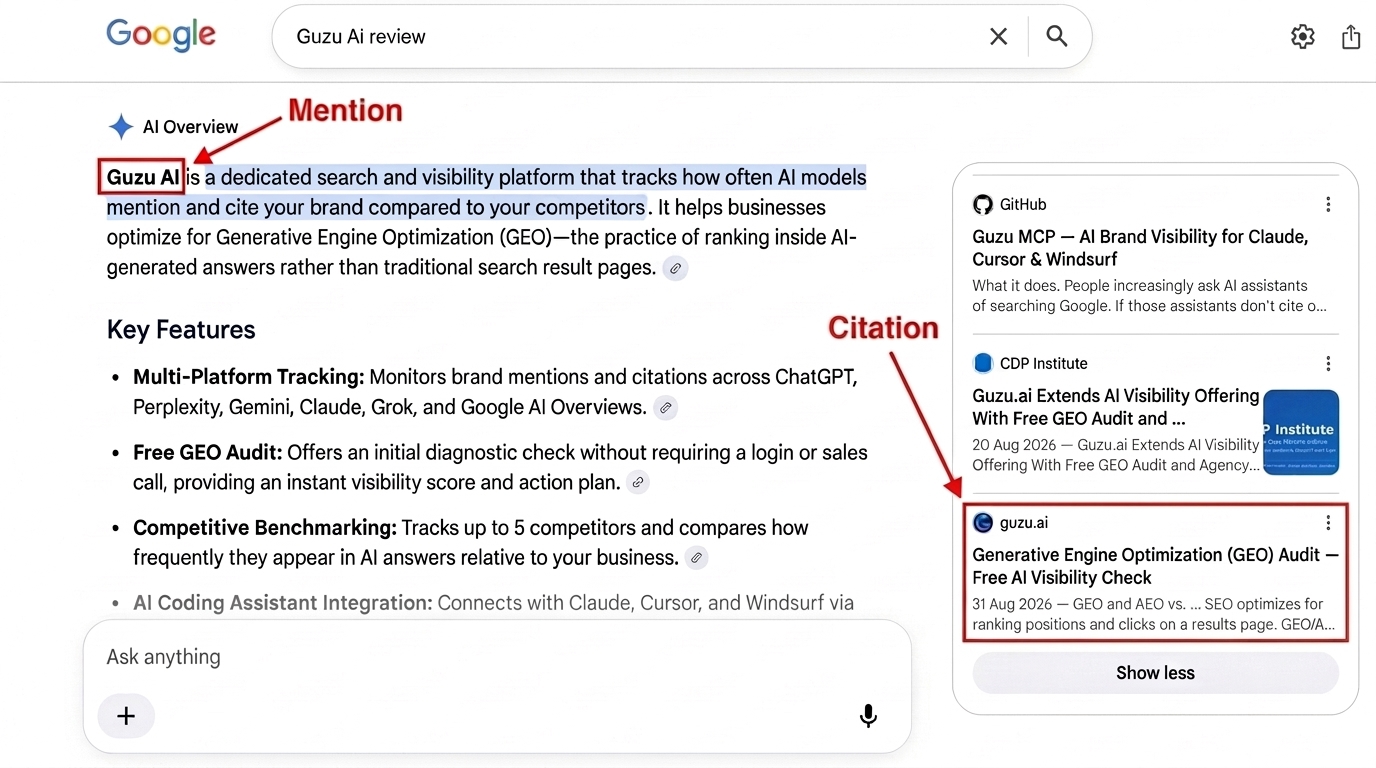
google.com — AI Overview
Guzu AI Overview citation and mention — annotated example showing a cited source and a brand mention inside the AI answer
Step 01

Set your baseline and keep track of changes.

The very first step is to choose the targeted keywords that you want to track and measure them by running them through any AI visibility platform — see how many citations and mentions you get for each, and begin tracking them. You should always keep track of the latest Google pattern changes and what types of websites Google weighs more heavily, so you can adapt your strategy.

Of course, you are always safe if you put your bets on high-authority third-party websites to add your footprint as an off-page strategy, and focus on EEAT for your own website. But for the set of targeted queries you want to rank for, you should always check the pattern.

As an example: for the query people may ask, "how to optimize your brand for AIO," you may notice Google relies on, say, 60% of citations from Reddit, 30% from YouTube, and 10% from LinkedIn to generate the answer. So here, writing blog content as a GEO strategy for this query is a waste of time and resources — you should have more of a presence on Reddit and YouTube.

But then why keep tracking? Because this behavior doesn't remain forever; it changes. It could be that Google shifts focus to reference listicles to answer users, and now you need to reach out to listicle websites. It's always moving, and you need to keep yourself updated by tracking daily citations and mentions with any AI visibility tracking tool — so that when you experience a drop, you can investigate whether there's a pattern change you need to catch up with.

guzu.ai — baseline tracking
AI Overview baseline report — citations and mentions tracked over time for targeted keywords
Step 02

Find the gaps — query by query.

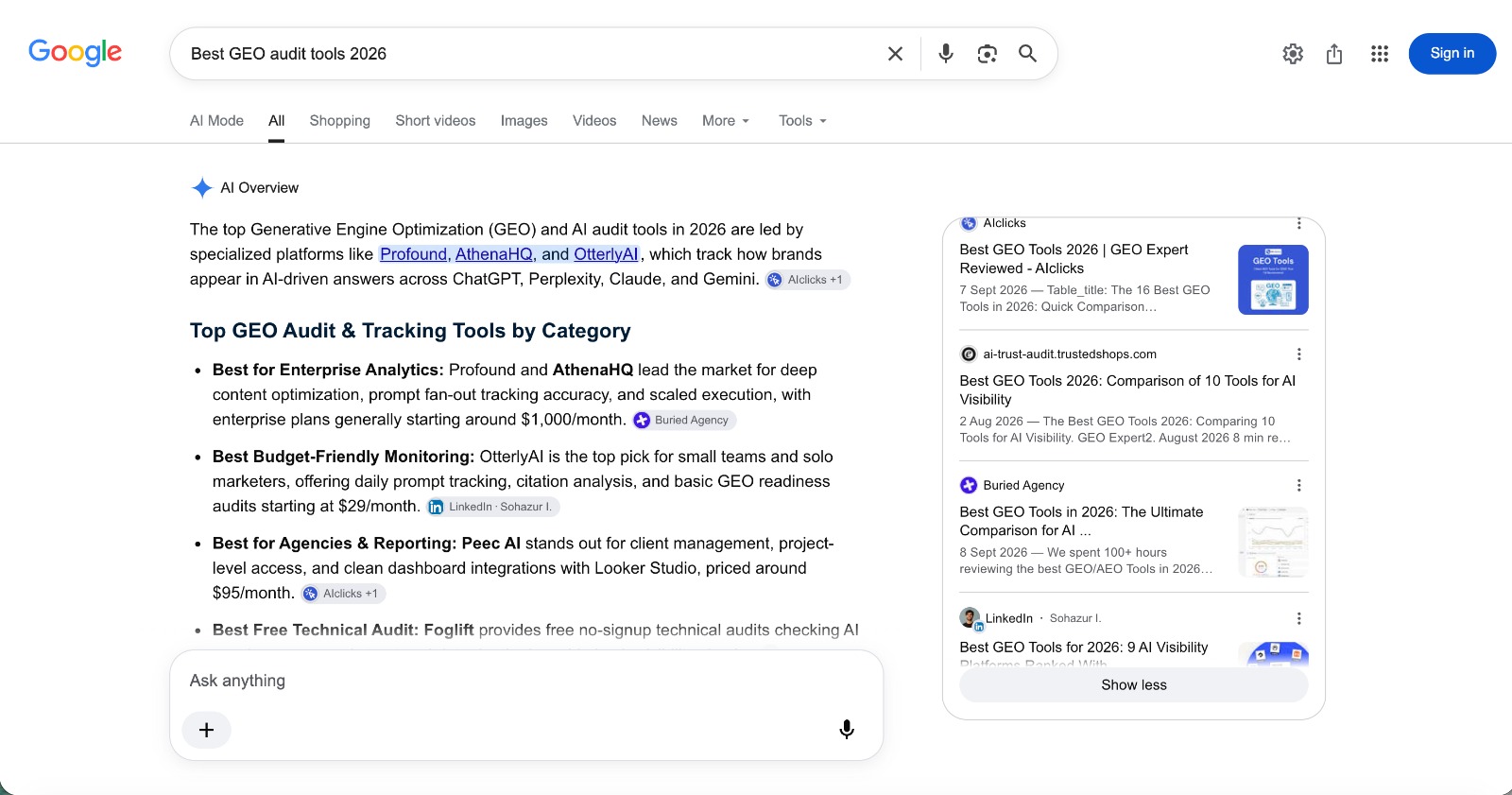
This is what we call competitive gap analysis, and it should be done down to the query level. Your journey begins by going one by one through the queries where you are invisible and checking why your competitors are showing up instead of you. I used Guzu as an example website I want to GEO optimize — and, well, I used Guzu as the AI visibility tool to do my gap analysis. Let's take the prompt "best GEO audit tools."

google.com — AIO for "best GEO audit tools"
Google AI Overview results for 'best GEO audit tools' — the AI answer with cited domains listed on the right side

As you can see in the image above, on the right side these domains are being cited: AIclicks, AI-trust-audit, Buried Agency, and one LinkedIn result. And if you look at the AI answer itself, I'm not being mentioned — I'm performing terribly for this prompt. Time to investigate why. Let's zoom in on the result pulled from Guzu in the image below.

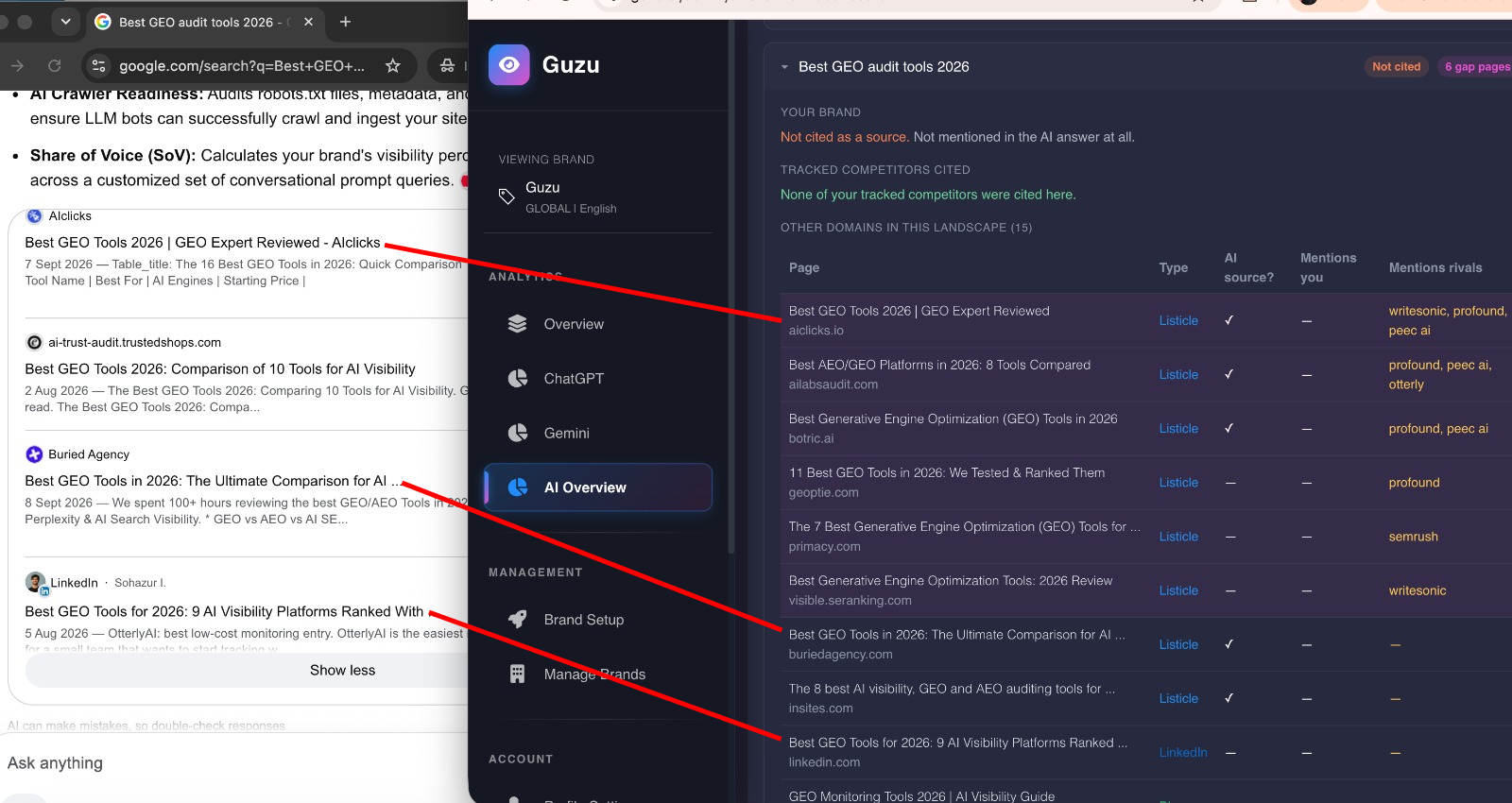
AIO results × Guzu insights — side by side
AI Overview results and Guzu insights side by side — cited domains for 'best GEO audit tools' with the mention rivals column showing competitors named in each source

With the AIO results and Guzu insights open side by side, I can see the cited domains are correctly captured — and beyond that, this works as a bonus for my citation and mention work. Look at AIclicks: the "mention rivals" column tells me that in their listicle, from the snippet Guzu extracted, my targeted competitors were being mentioned — Writesonic, Peec AI, and Profound. That leaves me two strategies to choose from:

Play A · Off-page

Get added where AI already looks

If a domain is being cited and it mentions my competitors but not me, I reach out and see if I can have my brand added to their listicle. This increases the probability of my brand also being captured by AIO — not a guarantee it will be used in the AI answer, but we are stacking the odds.

Play B · Content

Build the source Google wants to cite

Sometimes cited sites are impossible to get onto — or worse, they're direct competitors. AIclicks is Guzu's direct competitor, so our chances there are near zero. But the fact their listicle got selected as a source is a signal: publish a similar article on my own site and it could be picked as a source next time, with my brand in the list.

Back to the screenshot: someone's LinkedIn post also got cited. That's an easier target. For off-page, I can message the person to see if I can get listed — or, now that I know LinkedIn matters for this prompt, publish a similar post on my own LinkedIn page.

Read the pattern

Look at the "type" column: Google is heavily weighing listicles to answer this specific query. So a YouTube video or a branded Reddit thread may be wasted effort right now. But patterns change — next month Google may weigh different source types for the same query. For now, my action plan is clear: listicles it is.

// The trap most people miss

Being cited doesn't guarantee being mentioned.

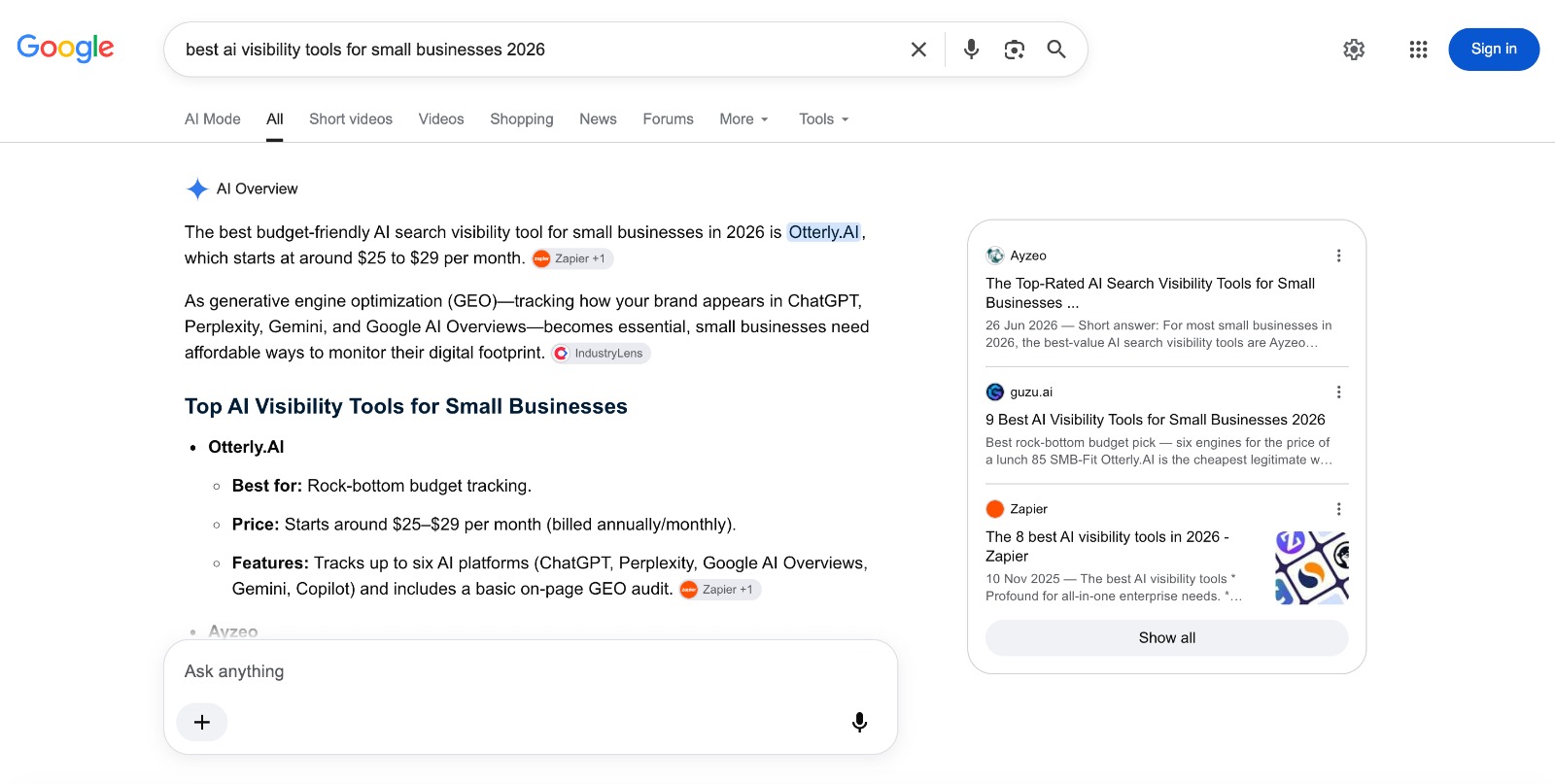
Say you go the content route: you write your own article, promote your brand inside it, and hope it gets picked up so you're mentioned to the user. That's not always how it goes. Look below — Guzu is being cited for "best AI visibility tools," but in the AI Overview answer, Guzu is not mentioned — even though the article names the brand.

google.com — cited but not mentioned
Guzu cited as a source for 'best AI visibility tools' while absent from the AI Overview answer — proof that citation does not guarantee a brand mention

The reason: AI Overview answers are not based on one source. They cross-check across multiple sources — and only if the majority, or a good portion, of those websites mention my brand and agree it's one of the best does my brand get mentioned. One article gets my foot in the door, but it may not be enough; I need more agreeing sources.

This isn't absolute, though. You could be named in only one article and still get mentioned — mainly when that source has very high authority (say, Wikipedia), giving the AI Overview full confidence to surface you.

The takeaway

Work both off-page and content to raise the probability of being mentioned and cited — and build your website's EEAT to raise its authority as a source.

// One engine, two surfaces

GEO optimizing for AI Mode.

It can be confusing whether you should spend time tracking and optimizing AI Mode or AIO. The short answer: they're almost the same. Google's own 2026 optimization guide explicitly treats them together as "generative AI features on Google Search" and says the same foundational SEO practices apply to both.

AI Overviews

The instant answer

Generated at the top of the results page for a single query. Your citation and mention work targets this surface directly.

AI Mode

The deeper research session

Built for follow-up questions — it retrieves more sources via query fan-out to answer more deeply. Same engine underneath, and every AI Mode journey begins with an AI Overview.

The practical consequence: optimize AIO for your brand and you will see improvement in AI Mode answers. There is no different strategy needed for each.

// The tracking stack

Which AI visibility tools track AIO.

Almost all the AI visibility tools out there track AI Overviews. Here are the most well-known ones for quick reference. Pricing may have changed between the time of writing and the time you read this — do your own research before buying.

ToolAI OverviewAI ModeCheapest setup tracking bothTracking allowance / catch
Otterly.AI add-on$38/moLite $29 + AI Mode $9. 15 prompts, daily. AIO included; AI Mode is extra.
Rankscalefrom $20/moEssentials starts at $20 but monitoring credits are extra. More realistic: Pro = $99/mo, 1,200 credits. Both AIO and AI Mode supported.
LLM Pulse€49/mo (~$60)50 prompts across ChatGPT, Perplexity, Gemini, AIO + AI Mode. €49 is weekly tracking; Starter with daily tracking is €79/mo.
Ahrefs Brand Radar — Custom Prompts$50/mo2,500 checks/mo. One prompt × one platform × one location = one check. Can track AIO + AI Mode without buying the $199 index.
Peec AI$95/moStarter: 50 prompts daily, choose 3 AI engines; both AIO and AI Mode are available choices. Unlimited users.
Semrush AI Visibility Toolkit$99/mo/domain25 tracked prompts, daily. AIO + AI Mode both covered; broader database research also includes both. $99 price is billed annually.
SE Ranking$89/mo add-on200 checks/mo; annual equivalent $71.20/mo. One prompt × one engine = one check. Supports AIO, AI Mode, ChatGPT, Perplexity and Gemini.
ProfoundEnterprise / customStarter $99 → limited engines. Growth $399 includes AIO, but AI Mode is listed under Enterprise capability.
ScrunchEnterprise / customCore $250/mo has AIO but not AI Mode. AI Mode joins AIO on Enterprise. Agency Core $500/mo also exists.

Legend — supported · add-on = costs extra. All pricing as published mid-2026 — verify with each vendor before purchasing.

// No subscription required

The most affordable way to track AIO.

You may not want to commit to a monthly subscription. Two pay-when-you-need-it approaches I personally use:

Option 01 · No-code

One-off GEO audits as checkpoints

Run a Guzu one-off GEO audit before you start optimizing for AIO — it hands you the practical action strategy for both content and off-page. Then every month or two, run another one-off audit and compare against your baseline to see how much you improved.

No monthly payment; you pay only when you want to see changes.

Pay per checkpoint
Option 02 · Technical

DataForSEO Labs API, pay-as-you-go

The DataForSEO Labs API is a bit more technical but affordable, and it works pay-as-you-go: you only pay to pull your prompts' citation and mention results when you want them.

If you use Claude, add DataForSEO as a custom connection — then in Claude Cowork, ask it to request an AI visibility report for your targeted prompts and pull it from DataForSEO.

Pay per request
Start with a baseline

Know where you stand before you optimize a single page.

Baseline first, gaps second, plays third — and re-measure on your schedule, not a subscription's.

Run a one-off GEO audit →