GEO SIGNAL — PRACTITIONER GUIDE
Updated Sep 2026 · v1.0
Technical · Content · Off-page

How to GEO optimize

Generative Engine Optimization shares its foundations with SEO, but the differences are where brands win or disappear. This is the working method — what to fix on your site, how to write so an LLM can actually use you, and the gap-analysis loop that took Guzu from zero ChatGPT visibility to being cited.

3
Pillars that decide GEO success
57
Prompts in the worked example
~37d
Until 90% of pages get cited
3mo
Freshness window that gets fetched
// 00 — Start here

GEO is SEO's cousin, not its replacement.

GEO optimization has a lot in common with SEO optimization at its core, but there are subtle differences. I recommend that if you don't know the basics of SEO, you read this article here before going deep into GEO optimization.

There are 3 different aspects of GEO optimization you need to take care of: 1) technical, 2) content, and 3) off-page strategy. I'll go deep into each so you can fully understand GEO optimization.

But before that, let's make sure we fully understand what GEO optimization is before we dig into the details. If you already know the term and its purpose, you can skip this section, go to Technical GEO, and continue reading from there.

Diagram explaining GEO optimization across ChatGPT, Gemini, Perplexity, Claude and Google AI Overviews
Fig. 1 — GEO optimization spans every conversational AI surface, not just one platform.
// 01 — Definitions

What GEO optimization actually means.

Generative engine optimization is the process of improving your brand exposure on conversational AI platforms. There are interchangeable terms that you may have heard and that may have confused you, such as AEO (Answer Engine Optimization) or AI SEO, as some less technical people use, but they all mean the same thing.

In layman's terms, it is optimizing for AI platforms, including ChatGPT, Gemini, Perplexity, Claude, and so on, you name it. And not to miss one of the important ones, AIO, or AI Overview, which is the AI-generated text that comes on top of Google SERP results.

So the effort is to influence the AI answers so that they recommend your brand to users.

What is AI visibility in GEO?

So the most common metric that we use to measure our GEO success is AI visibility. It shows how much exposure your brand has on AI platforms.

Each AI visibility tracking platform should have this metric, and they have their own way of measuring AI visibility. So tool by tool, this number for the same set of tracking prompts can show you different numbers. Don't expect to see the same number among all AI tracking tools; they calculate this differently.

Now, if you break down AI visibility, at its core there are two important pillars to track for KPI or success measurement: citation and mention.

Citation and mention metrics

Citation. Let me start with citation. I'm sure you have used ChatGPT to ask questions. The answer you get usually, if you have noticed, comes with clickable links as sources in each paragraph, and at the end of the answer you will see "Sources," where you click and on the right sidebar you see the references — the websites that ChatGPT gets its answers from. Those websites are called citations.

Reason 01

Referral traffic

Although it's not much as of now, that is one way to receive referral traffic from AI sources. When your website is listed as a cited source, users may click and visit your website from those links.

Reason 02

Borrowed authority

People see your website as an authoritative source that AI trusted for its answer, and you get the credit of trust for your brand. People trust your brand more as a source of truth.

The three pillars

Get these wrong in order and nothing else counts.

Pillar 01

Technical

Can AI bots reach and render your pages at all? Robots.txt directives and JavaScript-only rendering are the two blockers that silently void everything downstream.

Pillar 02

Content

Entity-rich, specific writing an LLM can parse without guessing. Vague claims and unnamed subjects lower the model's confidence in using you.

Pillar 03

Off-page

Your footprint on the third-party sources AI actually fetches and cites. Gap analysis tells you exactly which ones are worth the outreach.

Order matters. A perfect content and off-page programme delivers nothing if bots can't crawl the site in the first place.

// 02 — Technical GEO

If bots can't crawl it, nothing else matters.

Why do I begin with technical SEO? Because this is the most important part of GEO. If your website is not AI-friendly, no matter how good your other two strategies — content and off-page — are, it doesn't matter, since AI bots cannot discover your content and they cannot crawl your content.

Crawlability and discoverability

No matter how good your content or your product prices are, if AI agents cannot crawl your website, they won't discover your content and the value you are offering.

So the first important thing is robots.txt.

Robots.txt is the gate to your website. Check your robots.txt and make sure you are not blocking AI agents from visiting your pages.

Here is an example of your site blocking ChatGPT from reading your website content:

User-agent: GPTBot
Disallow: /

These directives will prevent AI agents from learning about your website when they are in the training stage, although it does not stop them from visiting your pages if they are live browsing.

What that means is when a user asks a question and, let's say, ChatGPT needs to get an answer, it visits your website. Usually, they don't respect the robots.txt because they don't visit the robots.txt page first to see if they are permitted or not. So basically, if you are trying to block them, it won't help anyway, but it prevents AI bots from training with your content.

So if, let's say, you are blocking ChatGPT in your robots.txt, and you open ChatGPT and ask, "What do you know about my brand or website? Don't browse. Without browsing, answer me," because in the past ChatGPT wanted to learn about your website but you blocked it in your robots.txt, it has no knowledge about your website.

So robots.txt works in that part, but anyway, you have to make sure you don't block it.

JS rendering

Most of these AI agents cannot crawl JS websites, so if your website is purely written in JS or is an SPA (single-page application), the bots literally see nothing on your page.

So for that reason, you need to make sure your content is crawlable and discoverable by these AI bots.

The solution is to make sure you have a static HTML version of your content loaded for bots. This can get more complicated, and I won't go deep into it, but there are many ways to do this: SSR (server-side rendering), dynamic rendering, and such.

Or at least have your meta information and important pieces of your content in the HTML version to give AI a clue about what this page is about. But my recommendation is to have a full HTML version of your JS page.

// 03 — Content optimization

Write in entities, not adjectives.

So for content, there is a set of rules to follow. It helps your content become easier to digest by LLM platforms, and you will be increasing the probability of having your content used to answer user prompts or your page cited as a reference.

Entity-based content

The first and foremost important rule is to make sure you use entities and avoid vague words.

Basically, AI brains simply work this way: they find entities in your content and then try to map them together to understand the context. I'll explain what an entity is and its relationship here. Let me give you one example.

Not AI-friendly

"We provide the best AI visibility tracking services in our area."

AI-friendly

"Guzu AI provides the best AI visibility tracking services."

Why is the first example not AI-friendly? Because it lacks entities.

First of all, who is "we"? Yes, although AI can guess it right by cross-checking other information on your website, you are adding an unnecessary risk of a wrong guess, and your ambiguity may lower the confidence of AI to use your content.

Now back to the wrong example. "Our area" is also another example of ambiguity. You need to be specific. Say the name of the area, city, or country.

So you would ask, what is an entity here? An entity is a person, organization, location, and so on. In our example, "we" is not an entity; Guzu.ai is. "Our area" is not an entity; the United States is.

Then AI can map these entities together to understand your sentence. So reduce the amount of guesswork for AI and be more specific.

Being more specific also helps differentiate your brand from competitors and prevents you from appearing as a generalist.

So instead of claiming on your website to serve the best coffee in the world, explain the process, the choice of grain, and what actually makes you the best coffee shop. Otherwise, everyone can simply claim to be the best, and it makes it difficult for AI to really see your value as different from others, and you will all look the same.

Although when choosing the best, AI will consider multiple sources for assessment, including people's reviews, for sure the most important initial research comes from your own website. So don't feed AI with general information about your products and services.

// 04 — Gap analysis

Find the sources AI already trusts, then get into them.

This is the fastest lever I've found. Rather than guessing where to publish, you read which sources the model actually fetches and cites for your prompts — and go there.

For me, one of the most effective and quick methods to boost the AI visibility of my brand is to use the gap analysis feature of Guzu AI.

When I first developed Guzu, ChatGPT and all other platforms literally had zero visibility and knew nothing about it. But now they are much more informed about the brand. Although the competition is fierce and it needs more action, let me walk you through the quick wins that changed the AI game for me:

Guzu AI gap analysis showing most frequently cited sources for ChatGPT, with fetch counts and citation rates
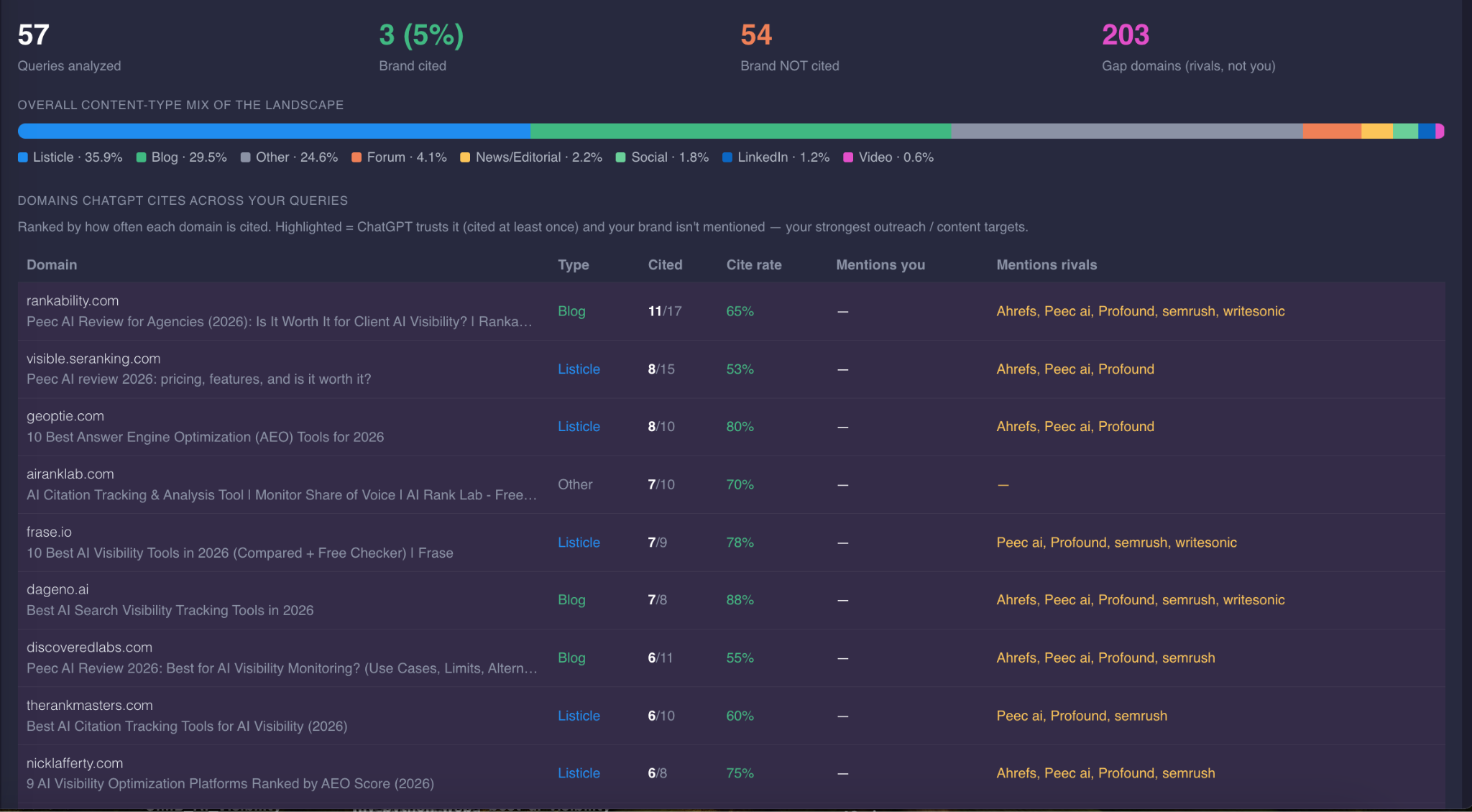
Fig. 2 — Source mix, fetch counts and citation rates across 57 tracked prompts.

So after auditing my website, I started with improving my brand in ChatGPT answers for both citations and mentions.

I analyzed 57 queries. My visibility was at 5%, and based on the prompts that I wanted to improve visibility for, based on the image, you can see that 35% of sources are listicles and 29% are blog posts. 4% are forums — it could be Reddit, but I can check that later in each individual prompt analysis that Guzu provides to see which forums my rivals are being mentioned in.

Moreover, 1.2% is LinkedIn and about 0.6% is YouTube. So I won't need to invest heavily in YouTube content or even LinkedIn to improve visibility. I'll put the effort mainly into listicles that don't mention me and blog posts.

So the image above shows the most frequently cited sources. What that means is, for the 57 prompts, a lot of times these websites have been used for answering. So having my name on them can improve multiple prompts at the same time.

For example, in the first row, Rankability.com was fetched 17 times by ChatGPT and cited 11 times. That gives it a 65% citation rate, which makes it the best target for me.

Read the ratio, not the volume

A website can be fetched 100 times but cited 0 times, meaning it was fetched but never used as a reference. So having my name in that listicle is almost pointless.

The off-page strategy here is simple. I just reach out to those most frequently used websites and see if they can place my name in their list. That's the quickest win, but not the easiest.

Sometimes those highly referenced websites could be your competitors, and they won't add you to their list, or they won't accept any additional edits to their post for you. But some may ask you to pay for placement, which is good.

The last two columns are self-explanatory. They show that I was not being mentioned in any of those sources, but almost all of my competitors were being mentioned. I should fit myself there too.

Guzu AI prompt-level analysis for 'Top AI visibility tools' showing which sources cite competitors
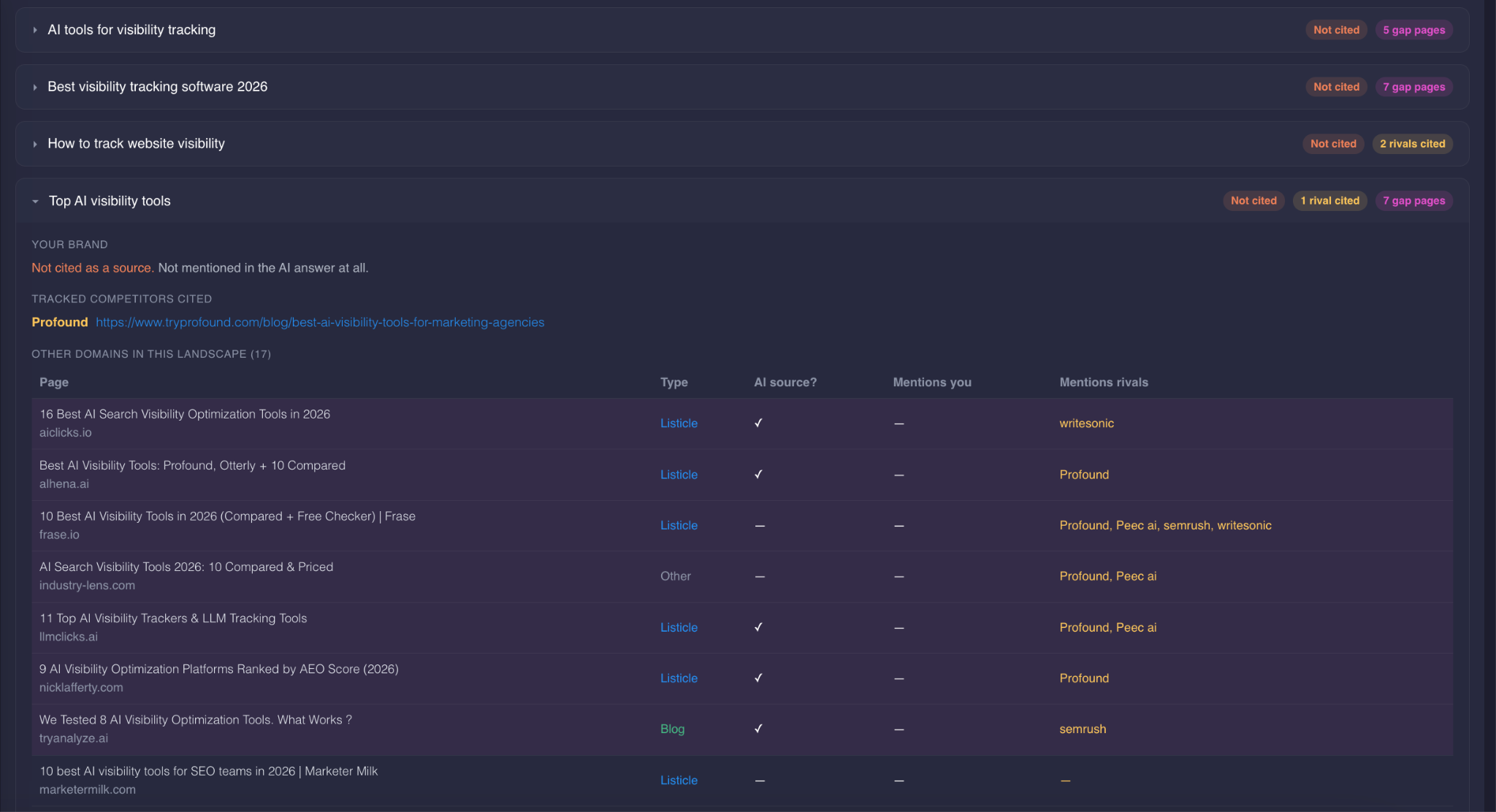
Fig. 3 — Prompt-level insight: which sources ChatGPT used for a single query, and who got cited.

Now, how do I laser-focus on a specific prompt that doesn't mention me or cite me? How do I target a specific prompt to mention me or cite me?

The good news is Guzu provides this insight at the prompt level.

As you can see in the image, I want to work on "Top AI visibility tools," where I'm not being cited, but one of my competitors, Profound, is being used as a reference and being cited.

Content gap strategy

So aside from the listicles where, for this specific prompt, I'm not in their list but competitors are, same as before, I check which website listicles are being used by ChatGPT and reach out to them to mention me in their list.

That's the off-page strategy. But how about the content strategy?

For that, I need to see which of my competitors' blog posts have been used as citations. If that topic is missing from my website, I write the same topic.

Or it doesn't necessarily have to be a competitor. If you look at the image, one row before the last, there is one website article that has been cited as a source, and Semrush was extracted from its blog post and mentioned in the AI answer.

And it's not even my competitor. If you see the title, it is: "We Tested 8 AI Visibility Optimization Tools: What Works."

So I can go to the link and read how the blog post was structured and have the same style of article with better information published on my website.

Because this shows that ChatGPT does pay attention to blog posts like this to get its answers. So if I have a similar blog post, I increase the chances of being cited and, well, being mentioned, since I will add my website name to the article.

// 05 — Fan-out queries

When the main prompt isn't enough, go one level down.

Now let's say, in the best-case scenario, for a particular prompt you added your footprint on third-party listicles, forums, or any other sources that ChatGPT or other LLMs pay attention to based on the gap analysis that we did, but still you are not being selected yet.

So your next strategy is to go deeper into fan-out queries.

What are fan-out queries?

When you ask a question on an LLM platform, let's say ChatGPT, that question is the main prompt. ChatGPT will take the same question and ask search engines to get search results and look for your answer in those results.

But that does not always give enough context for ChatGPT to best answer your question. For that reason, it breaks down your question into multiple questions that are related to your prompt.

Main prompt

"What's the best credit card to apply for?"

Fan-out

"What's the best cashback credit card?"

Fan-out

"What's the best travel rewards credit card?"

…and so on

So it breaks it down into different types of credit cards along with your main prompt and searches the SERPs to get the full context to give you the best answer.

So to increase the probability of being selected, you can collect the fan-out prompts. You can use fanoutfox.com — so far this is my favorite tool to research fan-out queries.

Then collect the fan-out queries and use the same Guzu feature for gap analysis, this time with fan-out prompts.

Then follow the same approach we just did with the main prompts: find the third-party sources as off-page opportunities to have your footprint there, or use them as part of your content strategy.

Fan-out query analysis in Guzu AI showing sub-queries derived from a main prompt
Fig. 4 — Fan-out queries: the sub-questions an LLM generates behind a single user prompt.
Where to start

Run the gap analysis before you write anything

Every step above depends on knowing which sources AI already fetches for your prompts. That reading takes minutes and changes what you'd otherwise spend months publishing.

STEP 01

Audit the baseline

See where you stand across engines and which prompts you're invisible for.

STEP 02

Read the source mix

Listicles, blogs, forums — find the highest citation-rate targets, not the highest fetch counts.

STEP 03

Work the two lists

Outreach for off-page placements; write the topics competitors got cited for.

// 06 — Timing and durability

How long it takes — and how long it lasts.

How long does it take to see GEO results?

This differs from AI platform to AI platform.

For me, the fastest has always been AI Overview. When I added my brand name on Reddit, literally after one or two days, if I recall correctly, the result was there.

Citations for ChatGPT can take longer. For me, from ChatGPT having zero knowledge about Guzu AI to having full knowledge about Guzu, it took somewhere between 1 and 2 months.

But aside from my personal experience, the latest research done by Profound shows 90% of pages being cited after around 37 days on ChatGPT and Claude.

Your 37-day checkpoint

So if you are optimizing specifically, let's say, for ChatGPT and you see no changes in ChatGPT for the targeted prompts in 37 days, it means you are not optimizing properly and you need to revisit your method.

But from the community, I have seen people report that they saw results after one or two days. These are just individual experiences; there is no data backing that.

How long do GEO results last?

One thing you should know: GEO is not a one-time win that you enjoy forever.

No. Placements change. Citations and mentions change over time.

The freshness of content matters. Recency can be a reason to be selected. Based on my own experiment I did last time, most of the articles fetched for citation contained publication dates from the last 3 months.

Some articles, even though they were very complete and deserved to be cited for the prompt that I tested, were fetched but not used as cited sources. I checked them, and they did not have recent publication dates.

So the point is, you need to maintain the result. You need to constantly update your site with fresh content and also continue producing answers in the content for targeted prompts, either on your website or on third-party websites as part of your off-page strategy.

For AIO, I've been observing that even though you can appear very fast, it constantly changes the cited sources, AI answers, and mentions.

You need to keep an eye on your brand, and with any new changes, if you disappear, you need to plan a new content and off-page strategy.

// 07 — Last words

Subscription or one-off audit?

You may ask: for GEO optimization, do I need to subscribe monthly to AI visibility tools, or is a once-in-a-while GEO audit sufficient?

It depends on how deep you want to go with GEO.

You should know that the citation and mention results of your targeted brand fluctuate. So today, for the same prompt, you may see 10 citations, tomorrow 6.

That's why AI tools report daily or weekly, because you get the average visibility.

For an audit, one time gives you good enough context to work on your brand visibility, and it usually covers most of what you need to do to improve visibility.

Although the citation and mention numbers that you see from a one-time audit should not be seen as a fixed, definitive number. Take them as a rough number showing whereabouts you are.

I'm going to be honest with you: for Guzu itself, I used the audit two times, before and after following the gap analysis, and it worked perfectly well for me.

So if you want to save the cost of a monthly payment, I would recommend one audit per month under the condition that during the month you do the optimization and check the result.

A subscription gives us a more granular view and more context if you want to go really detailed and deep.

For instance, in Guzu, one of the unique features for professional optimization is being able to see the frequency of citations and mentions for each prompt and how volatile your citations and mentions are.

If it is too volatile — meaning today it shows 10 citations and tomorrow 0 citations — it means you need to have more footprint off-page and more content to make the visibility stable.

So both work. It all depends on how deep you want to continue optimizing for each prompt.
// Straight answers

GEO optimization, in short.

What is GEO optimization?

Generative Engine Optimization is the process of improving your brand's exposure inside conversational AI platforms — ChatGPT, Gemini, Perplexity, Claude, and Google's AI Overviews. AEO and AI SEO are interchangeable terms for the same thing.

What are the three parts of GEO optimization?

Technical (making sure AI bots can crawl and render your site), content (writing entity-rich, specific content AI can digest), and off-page (getting your brand into the third-party sources AI actually cites). Order matters — technical blockers void the other two.

How is AI visibility measured?

AI visibility breaks down into two pillars: citations (your site listed as a clickable source) and mentions (your brand named in the answer text). Every tracking tool calculates the composite score differently, so don't expect the same number across tools.

How long does GEO optimization take to show results?

It varies by platform. AI Overviews can move in one to two days. For ChatGPT, research from Profound shows 90% of pages get cited after roughly 37 days — so if a targeted prompt hasn't moved in 37 days, your method needs revisiting.

Do GEO results last?

No — placements shift constantly. Freshness matters: most articles fetched for citation carry publication dates from the last three months. You have to keep content updated and keep building off-page footprint to hold visibility.

Do I need a monthly subscription or is one audit enough?

Both work. One audit per month is enough if you actually do the optimization during that month and re-check. A subscription gives a granular view — per-prompt citation frequency and volatility — which matters when you're optimizing prompt by prompt.

The takeaway

Fix the crawl. Name the entities. Go where AI already looks.

Those three moves, in that order, are the whole method. The gap analysis is what tells you where "where AI already looks" actually is for your prompts.

Run a free GEO audit →